Maven Central Publishing Limits⚓︎
Info
This page reflects the current state of Maven Central publishing limits. It is not a changelog — individual changes are not called out inline, and it does not cover the history or context behind how decisions have evolved.
We are actively responding to feedback from the community as this program evolves, including an extended timeline, adjustments to the metrics used to evaluate publishing activity and to how exemption requests are handled. For a summary of recent changes and the context behind them, see Latest News or the News Archive.
What Changed?⚓︎
Maven Central has introduced publishing usage visibility and limits for high-volume publishing activity. These limits are focused on the highest-volume publishing patterns across Maven Central, based on usage data from roughly the top 10% of publishers.
Most community open-source projects should not be affected. Maven Central remains free for ordinary community open-source publishing. Community open-source projects with unusual publishing patterns may request higher limits or an exemption for review.
Publishing volume is only one of two independent factors that determine whether a paid subscription is required. The second is whether any published artifact has a commercial nature — meaning it supports the adoption, integration, or operation of a commercial product or service. Commercial-nature artifacts require Maven Central Publisher Pro from October 1, 2026, regardless of publishing volume, even if the organization's overall file count, release size, and release count remain within the free thresholds described on this page. See Company or Commercial Publishing for details.
Why Did Sonatype Make This Change?⚓︎
This change is part of a broader industry effort to keep public package infrastructure reliable, secure, and open for the long term. Across ecosystems, registries are facing the same pressures: rising automation, CI/CD, security scanning, machine-driven software supply chains, and commercial platforms using public registries as production infrastructure.
For more context on this broader effort, see:
- Open Infrastructure Is Not Free: A Joint Statement on Sustainable Stewardship
- Open Infrastructure Is Not Free, Part II: The Hidden Cost of Running Package Registries
- Open Is Not Costless: Reclaiming Sustainable Infrastructure
- Maven Central and the Tragedy of the Commons
- Beyond IPs: Addressing Organizational Overconsumption in Maven Central
- Open Publishing, Commercial Scale
Maven Central is part of that same shift. It is critical infrastructure for the Java ecosystem: a shared place where community open-source projects publish release-ready components and millions of developers reliably consume them.
But publishing demand is no longer evenly distributed. Maven Central now supports both ordinary community open-source releases and high-scale publishing patterns from commercial platforms, automated pipelines, SDKs, generated clients, agents, integrations, and other software delivery systems.
Those patterns create a different kind of demand on shared infrastructure. In some cases, Maven Central is being used not just as community open-source distribution, but as the last-mile delivery channel for commercial software ecosystems.
The data shows that publishing demand is concentrated. In the past 90 days, 10% of namespaces accounted for:
- more than 88% of all files published to Maven Central
- more than 90% of total storage consumed by new releases
- over 70% of all new release events
Info
Publishing size, file count, and release frequency are useful signals for identifying these patterns. They are not perfect measures of intent, and they are not meant to punish legitimate open-source activity. They create a review point where publishing behavior looks like commercial-scale or infrastructure-driven distribution, so Maven Central can preserve free publishing for the community while giving higher-volume commercial and infrastructure-scale publishers a clear path that helps support the infrastructure they depend on.
What Stays the Same?⚓︎
Maven Central's core purpose has not changed. It remains a public distribution platform for release-ready community open-source software in the Java ecosystem.
For most publishers:
- Existing publishing workflows remain unchanged.
- Public artifacts already published to Maven Central remain available for download.
- Developers and consumers can continue to rely on Maven Central as the default source for public Java components.
- Community open-source projects should generally be unaffected by these limits. Projects with unusual publishing patterns can request higher limits or an exemption for review.
These changes are focused on high-volume publishing patterns that operate at commercial or infrastructure scale. They are not intended to disrupt community open-source publishing, emergency fixes, or legitimate projects whose publishing patterns happen to look unusual in the data.
What Are the Maven Central Publishing Limits?⚓︎
Maven Central tracks three monthly publishing metrics per organization: file count, release size, and release count. Limits are evaluated per organization and may include one or more namespaces.
Based on community feedback, publishing limits are useful checkpoints for identifying patterns that warrant a closer look, but they do not translate cleanly into commercial pricing. Separate commercial pricing models have been built rather than using publishing limits as the primary basis for pricing. File count, release count, and release size remain tracked metrics used to identify unusual publishing behavior. See Latest News for the latest on this.
The current thresholds, your organization's usage, and where your organization stands relative to those thresholds are available in the Usage Center. Because thresholds may be adjusted over time as we better understand real-world publishing patterns, the Usage Center is the source of truth for current limits, warnings, and trends.
The Usage Center is also where publishers should expect to see advance warning before publishing is affected. Warnings are intended to give publishers time to understand usage, respond to growth, correct namespace or organization issues, request higher limits or an exemption, or move to a paid option before enforcement occurs.
The charts below show how publishing activity is distributed across Maven Central. They provide context for why the limits are focused on the highest-volume publishing patterns rather than ordinary community open-source release activity.
These limits are evaluated as hard thresholds against an organization's usage during the current calendar month. Each month starts fresh: an isolated large release, an unusually high file count, or an urgent security fix counts at full weight against that month's threshold. See Grace Periods below for what happens when a threshold is exceeded.
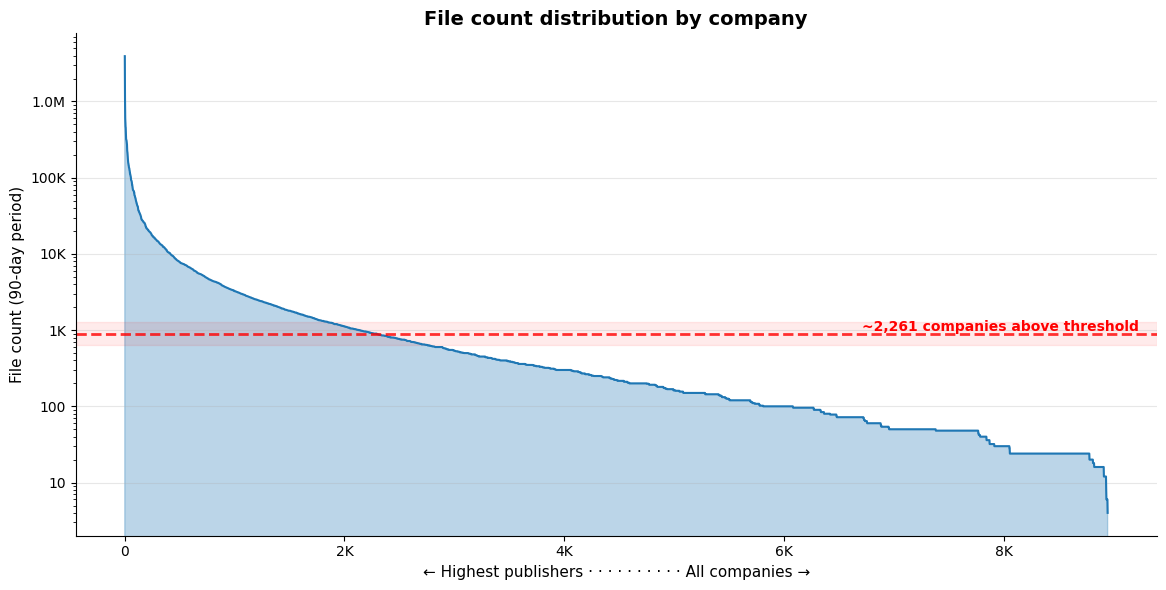
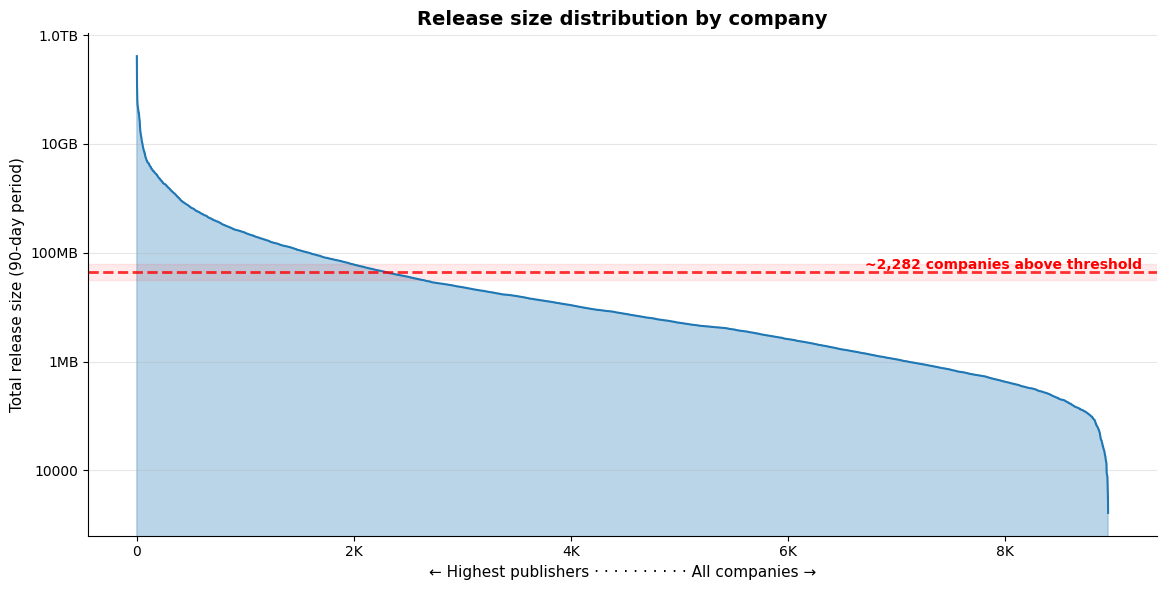
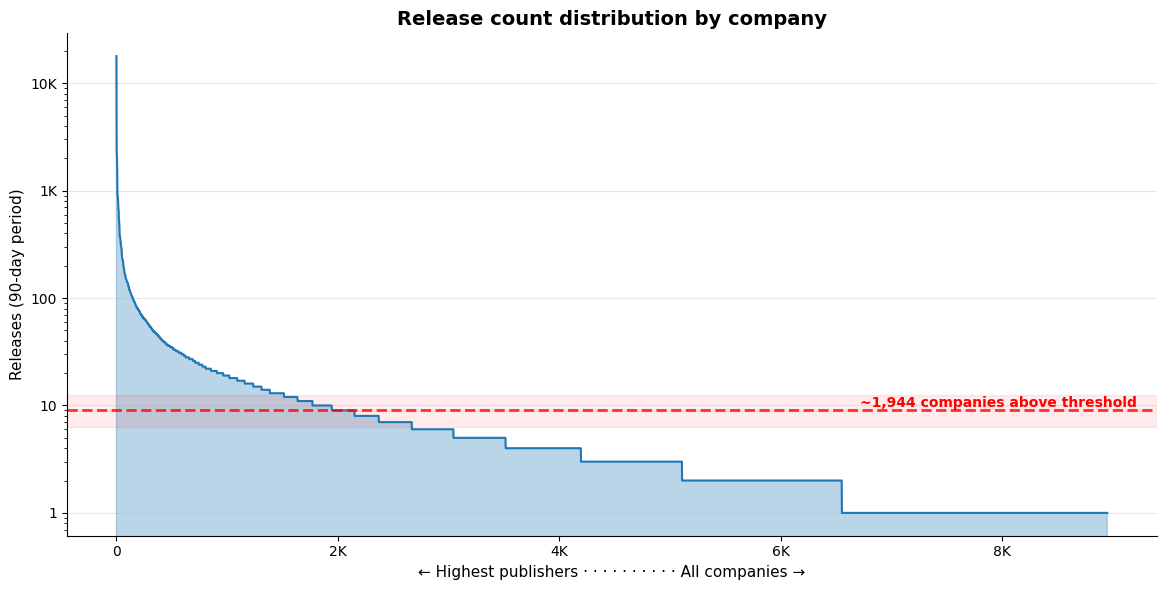
The table below shows monthly publishing volumes at selected percentiles across all Maven Central organizations, based on the past 90 days of data. Limits are set at the point where the top 10% of publishers by volume begin.
| Percentile | File Count | Release Size (MB) | Release Count |
|---|---|---|---|
| 90th | 1,167 | 78 | 7 |
| 91st | 1,310 | 94 | 7 |
| 92nd | 1,538 | 115 | 8 |
| 93rd | 1,852 | 150 | 9 |
| 94th | 2,269 | 193 | 11 |
| 95th | 2,805 | 247 | 13 |
| 96th | 3,824 | 349 | 15 |
| 97th | 5,188 | 522 | 19 |
| 98th | 8,030 | 877 | 27 |
| 99th | 17,724 | 1,808 | 50 |
Note
If you notice discrepancies in how your namespaces are organized, contact central-support@sonatype.com.
Most community open-source projects are expected to remain unaffected. Projects with unusual publishing patterns can request higher limits or an exemption for review.
Grace Periods⚓︎
Exceeding a threshold in a given month initiates a 30-day grace period rather than immediate enforcement. The goal is not to stop legitimate bursts of activity, such as an urgent security release, but to identify organizations that exceed limits repeatedly or on a sustained basis.
This grace period resets after 2 consecutive months of being below limits, so a future breach initiates a new 30-day grace period rather than immediate enforcement. This 2-month window may be re-evaluated over time as we continue to learn from community feedback and real-world publishing patterns.
If a grace period expires while an organization is still over a threshold, new releases that would keep the organization over that metric's limit are no longer accepted. This applies to the specific metric and scope (organization or namespace) that exceeded the limit; it is not a blanket suspension of all publishing across the organization. Namespaces or artifacts with an approved higher limit or exemption are evaluated against their own adjusted threshold and are unaffected by another namespace's grace period expiring.
If you anticipate a release that may push your organization over a threshold for the month, contact central-support@sonatype.com in advance so we can work with you before you publish.
How to Monitor Usage⚓︎
You can find your organization's publishing usage by logging into Maven Central and navigating to Publishing -> Usage Center.
The Usage Center displays organization-level metrics aggregated across all namespaces, including:
- Release size
- File count
- Release count
Usage cards show whether your organization is within limits, approaching limits, or at critical levels. Warnings begin before publishing is affected so publishers have time to understand what is happening and decide what to do next.
You can also view namespace-level metrics in a detailed table. Data visibility depends on your access permissions within the organization. Usage data can be exported as CSV for further analysis.
The View Trends option shows usage trends over the last three months for context. Limits are evaluated on the current calendar month alone, so the trend view helps you see whether a given month's usage was an isolated event, such as a security fix or short-term release spike, or part of a sustained pattern, even though each month is enforced independently.
If your organization is approaching one or more publishing limits, use the Usage Center to identify which metric is driving your usage. Then review Reducing Publishing Usage for practical guidance on reducing file count, release size, or release frequency.
If your usage appears incorrect, check whether your namespaces are grouped as expected under your organization. If the grouping looks wrong, contact central-support@sonatype.com with the relevant organization, namespace, and a description of the issue.
What Should I Do Next?⚓︎
If your organization is within the free limits and does not publish any artifact of a commercial nature, no action is required.
If any artifact you publish has a commercial nature — meaning it supports the adoption, integration, or operation of your organization's commercial product or service — Maven Central Publisher Pro is required from October 1, 2026, regardless of your organization's publishing volume. See Company or Commercial Publishing.
If your organization is approaching or exceeding the free limits, start by identifying which path best describes your publishing activity.
Before requesting higher limits or evaluating Maven Central Publisher Pro, review your publishing usage to determine whether it can be reduced. Many organizations can lower their file count, release size, or release frequency by removing unnecessary generated artifacts, optimizing build configurations, or consolidating releases. See Reducing Publishing Usage for practical recommendations.
Community Open Source Publishing⚓︎
Use this path if your project is primarily publishing release-ready community open-source software for public use in the Java ecosystem.
Community Open Source Publishing — details
Most community open-source projects should not be affected by these limits. Maven Central remains free for ordinary community open-source publishing. The current thresholds are drawn from analysis of all publishing activity over the last three months and set at approximately the top 10% of publishers by volume.
Some legitimate community open-source projects may have unusual publishing patterns. A project may publish frequently, produce many platform variants, include native binaries, generate many related artifacts, or need to publish urgent security fixes. Those patterns may look unusual in usage data even when the project is operating in good faith and serving the community.
If your community open-source project receives warnings in the Usage Center or appears to be approaching limits, review your usage first. Limits are evaluated against your organization's usage during the current calendar month, so the trend view can still help you see whether a given month reflects a sustained pattern or a one-off event. Because each month is evaluated on its own, an occasional burst or emergency release counts in full for that month and can push you over a threshold even as a one-time event, but an isolated over-limit month triggers a grace period rather than immediate enforcement. If you expect a release that may push your usage over a limit for the month, contact central-support@sonatype.com in advance.
If your usage is expected for your project, you may request higher limits or an exemption for review. The intent is not to create an ongoing monthly approval process for legitimate community open-source projects. Once the project and publishing pattern are understood, the organization can be adjusted appropriately.
When contacting central-support@sonatype.com, include:
- Namespace
- Organization
- Description of the project
- Explanation of the publishing pattern
- Whether the usage is sustained, occasional, or related to a specific event such as a security fix
- Reason higher limits or an exemption are needed
Company or Commercial Publishing⚓︎
Use this path if any artifact you publish has a commercial nature — meaning it supports the adoption, integration, or operation of your organization's commercial product or service. This may include SDKs, generated clients, drivers, agents, integrations, platform components, or build tooling tied to a commercial offering, regardless of publishing volume.
Company or Commercial Publishing — details
Commercial classification is independent of publishing volume. If one or more of your published artifacts has a commercial nature, a paid Maven Central Publisher Pro subscription is required from October 1, 2026, even if your organization's overall publishing activity remains within the free limits described earlier on this page. The free limits are a volume checkpoint for community open-source publishing — they do not create a volume-based carve-out for commercial-nature artifacts.
This applies broadly, including to SDKs, generated clients, drivers, agents, integrations, platform components, commercial open-source projects, developer tools, and other software published as part of a business or commercial delivery model — whether that publishing activity is small or large.
Maven Central Publisher Pro provides increased publishing capacity and access to Sonatype support for organizations publishing SDKs, generated clients, agents, integrations, platform components, developer tools, or other release streams through Maven Central as part of a commercial delivery model.
If your organization publishes a mix of commercial-nature artifacts and genuinely community open-source artifacts that are not part of any go-to-market activity, you can request that the community artifacts be excluded from commercial classification on a per-artifact or per-group-id basis, rather than treating the whole organization as commercial. See Requesting a Per-Artifact or Group-ID Exemption.
Learn more about Maven Central Publisher Pro and evaluate whether it is the right option for your organization.
Requesting a Per-Artifact or Group-ID Exemption⚓︎
If your organization is otherwise commercial but some namespaces or group IDs are genuinely community open source and not part of any commercial go-to-market activity, you can request that those specific artifacts or group IDs be excluded from commercial classification, rather than requesting an exemption for the organization as a whole.
When contacting central-support@sonatype.com, include:
- Organization
- The specific namespace(s) or group ID(s) you are requesting exemption for
- Description of the project and why it is not part of a commercial go-to-market motion
- Confirmation of which, if any, of your organization's other artifacts remain commercial in nature
Approved per-artifact or group-id exemptions may change which Maven Central Publisher Pro tier, if any, is appropriate for your organization's remaining commercial-nature publishing.
Frequently Asked Questions⚓︎
Are these limits final?
Not necessarily. Thresholds may be adjusted as we learn more from actual publisher behavior, community feedback, namespace grouping issues, and exemption requests.
Will I receive warning before publishing is blocked?
Yes. The Usage Center is intended to provide advance warning before enforcement affects publishing. Publishers should see when their organization is approaching or exceeding limits, giving them time to review usage, adjust publishing patterns, correct namespace or organization issues, request higher limits or an exemption, or move to a paid option if appropriate.
The goal is that publishers are not surprised by a block.
Are limits based on one release, one day, or one unusual spike?
Not on their own. Limits are hard thresholds on file count, release size, and release count, evaluated against an organization's usage during the current calendar month, not averaged across multiple months, so a single large release can push an otherwise well-within-limits organization over a threshold for that month. But exceeding a threshold in one month triggers a grace period rather than immediate enforcement. Enforcement is reserved for organizations that exceed limits repeatedly or on a sustained basis, not an isolated spike.
If you expect a release, including an urgent security fix, that may push your usage over a threshold, contact central-support@sonatype.com in advance so we can work with you before you publish.
How long is a grace period, and can it be extended?
Exceeding a threshold initiates a 30-day grace period. This grace period resets after 2 consecutive months of being below limits, so a future breach initiates a new 30-day grace period. This 2-month window may be re-evaluated over time as we continue to learn from community feedback and real-world publishing patterns.
If you need more time — for example, you're actively working to reduce usage or waiting on an exemption decision — contact central-support@sonatype.com before the grace period ends. Extensions are handled case by case.
What exactly gets blocked when a grace period expires?
Enforcement applies to the specific metric and scope (organization or namespace) that exceeded its limit, not a blanket suspension of all publishing. Once a grace period expires while usage remains over a threshold, new releases that would keep that organization or namespace over the limit are no longer accepted until usage is reduced, a higher limit or exemption is granted, or Maven Central Publisher Pro is in place.
Namespaces or artifacts with their own approved higher limit or exemption are evaluated against their own threshold and are unaffected by another namespace's grace period expiring. Already-published artifacts are never affected — see the FAQ below on what happens to artifacts that are already published.
What happens if my project needs to publish an urgent security fix?
Because limits are evaluated against your organization's usage during the current calendar month, a single urgent security release counts at full weight against that month's threshold. But an isolated month over a threshold triggers a grace period rather than immediate enforcement. The intent is not to stop legitimate bursts like a security release, so this is not something you need to face alone.
If your project needs to publish an urgent security fix or other time-sensitive community release and you are concerned it may push your usage over a threshold for the month, contact central-support@sonatype.com before publishing. We will work with you to make sure legitimate community open-source releases can get out.
Do these limits apply to community open-source projects?
By design, the limits are set at approximately the 90th percentile of all publishers by volume, meaning roughly 90% of all projects are unaffected. Maven Central remains free for ordinary community open-source publishing.
Some legitimate community open-source projects may have unusual publishing patterns, such as frequent releases, many platform variants, native binaries, generated artifacts, or large release outputs. Those projects can request higher limits or an exemption for review.
What qualifies for higher limits or an exemption?
Higher limits or exemptions are intended for legitimate community open-source projects whose publishing patterns exceed the default thresholds but are still consistent with Maven Central's role as public open-source infrastructure.
Examples may include projects with unusual release models, many supported platforms, native binaries, large but legitimate artifacts, generated artifacts required by the project, or urgent security-related publishing needs.
Each request is reviewed based on the project, organization, namespace, and publishing pattern.
Before requesting higher limits, review the recommendations in Reducing Publishing Usage. Many publishers are able to reduce file counts, release size, or release frequency without changing the functionality of their releases.
Is an exemption a recurring monthly approval process?
That is not the intent. For legitimate community open-source projects, the goal is not to create an ongoing bureaucracy. Once the project and publishing pattern are understood, the organization can be adjusted appropriately.
What if my project is open source but backed by a company?
Open source projects backed by companies are not automatically excluded from community open-source treatment. The important distinction is what the project is used for. Generally speaking, if the project is not part of a commercial go-to-market motion, it will qualify for community open-source treatment.
If the project is primarily publishing release-ready community open-source software for public use in the Java ecosystem, it may qualify for higher limits or an exemption if its publishing pattern is unusual.
If Maven Central is being used as part of a company's commercial distribution path for SDKs, generated clients, agents, integrations, platform components, developer tools, or customer-facing software delivery, Maven Central Publisher Pro may be the appropriate path.
If I stay within the free publishing limits, can I avoid a paid subscription for commercial-nature artifacts?
No. Publishing volume and commercial classification are evaluated independently. The free limits described earlier on this page are a volume checkpoint intended for ordinary community open-source publishing. If any artifact you publish has a commercial nature — meaning it supports the adoption, integration, or operation of your organization's commercial product or service — a paid Maven Central Publisher Pro subscription is required from October 1, 2026, regardless of your organization's file count, release size, or release count.
This applies to a wide range of commercially-related open-source projects, including SDKs, client libraries, drivers, integrations, and build tooling maintained by a commercial organization, even when that project's own publishing activity is small.
If part of your organization's publishing is genuinely unrelated to any commercial go-to-market activity, see Requesting a Per-Artifact or Group-ID Exemption.
What counts as company or commercial publishing?
Company or commercial publishing generally means Maven Central is part of how a business distributes software to customers, users, platforms, integrations, or downstream systems.
This may include SDKs, generated clients, agents, integrations, platform components, commercial open-source projects, developer tools, or other software published as part of a commercial product, service, or delivery model.
Commercial publishing through Maven Central is legitimate and often valuable to the Java ecosystem. But commercial enterprises that rely on open-source infrastructure as part of their business have a responsibility to help support that infrastructure.
Why are limits evaluated at the organization level?
Limits are evaluated at the organization level because publishing activity is often managed across multiple namespaces, projects, teams, or release pipelines within the same organization.
If your namespaces are grouped incorrectly, or if the organization-level view does not match how your project is actually governed, contact central-support@sonatype.com with the relevant organization, namespaces, and a description of the issue.
What if my Usage Center data looks wrong?
First, check the namespace-level detail in the Usage Center. Usage is aggregated at the organization level, so unexpected namespaces or project groupings may explain the numbers.
If the data still appears incorrect, contact central-support@sonatype.com with:
- Organization
- Namespace or namespaces
- Description of the issue
- Why the usage appears incorrect
- Any relevant context about project ownership or publishing workflow
Why use file count, release size, and release count?
No single metric perfectly distinguishes community open-source publishing from commercial-scale or infrastructure-driven publishing.
File count, release size, and release count are useful signals because they help identify sustained high-volume publishing patterns. They are not perfect measures of intent, which is why Usage Center warnings, higher-limit requests, and the exemption review process all exist.
Some projects may also be doing things that are unexpected or unusual — packaging extremely large artifacts, generating an unusually high number of files, or publishing at a release frequency that does not match typical community open-source patterns. These metrics create an inspection point to start a conversation about what is actually going on. Maven Central operates at a scale that makes it impossible to inspect every project up front, so this process is designed to surface the cases that warrant a closer look.
Based on community feedback, publishing limits are useful checkpoints for identifying patterns that warrant a closer look, but they do not translate cleanly into commercial pricing. Separate commercial pricing models have been built rather than using publishing limits as the primary basis for pricing. File count, release count, and release size remain tracked metrics used to identify unusual publishing behavior. See Latest News for the latest on this.
Why does file count include signatures, checksums, source jars, javadocs, and related files?
Because the thresholds are derived from actual Maven Central publishing activity, the inclusion of these files should not affect any project disproportionately. Every publisher produces signatures, checksums, POMs, source jars, and javadocs — these files are part of what everyone publishes by definition, so they are already reflected in the usage data the thresholds are based on. The ratio of supporting files to primary artifacts is roughly consistent across the ecosystem, meaning the resulting limits are proportional regardless of how you count.
Counting only primary artifacts would also introduce ambiguity that is difficult to resolve consistently. It can be very hard to distinguish a main artifact from an attached artifact, and Maven Central supports many different packaging systems with different conventions. Files are straightforward to count, and because the limits are derived from real usage patterns rather than an arbitrary multiplier, the metric works fairly even if the raw number looks large.
What about SDKs, generated clients, agents, integrations, native binaries, or many platform variants?
These publishing patterns can produce high file counts, large release sizes, or frequent releases. Whether they fall under community open-source review or Maven Central Publisher Pro depends on what the project is used for.
If the project is primarily community open source and not part of a commercial go-to-market motion, request higher limits or an exemption for review.
If the publishing supports a company's commercial distribution model, customer integrations, platform delivery, generated client strategy, agent distribution, or other business workflow, Maven Central Publisher Pro may be the appropriate path.
What happens to artifacts that are already published?
Already-published artifacts remain available under Maven Central's normal immutability model. Publishing limits do not remove existing artifacts when an organization approaches or exceeds a limit.
What happens if an organization stops paying for Maven Central Publisher Pro?
Already-published artifacts remain subject to Maven Central's normal immutability model. Stopping a paid plan does not remove previously published artifacts.
Future publishing capacity may be affected if the organization exceeds free limits and no paid option, higher limit, or exemption is in place.
Does this affect people downloading dependencies from Maven Central?
No. These publishing limits apply to publishing activity, not dependency consumption. Download-related rate limits and abuse controls are separate from publishing limits.
Does this mean Maven Central is no longer free?
No. Maven Central remains free for ordinary community open-source publishing that is not part of a commercial go-to-market motion. Most community open-source projects should not be affected.
The paid path applies in two independent situations: organizations whose overall publishing volume regularly exceeds the free limits, and organizations that publish any artifact of a commercial nature, regardless of volume. See Company or Commercial Publishing for details.
Will self-service Publisher Pro be available?
The intent is to provide a clearer path for organizations that need higher publishing capacity, including self-service options where appropriate. Organizations that already know they publish at commercial or infrastructure scale can contact Sonatype to discuss Maven Central Publisher Pro.
Who should I contact if I need help?
Start with the Usage Center. It shows your organization's publishing usage, thresholds, warnings, namespace-level details, and trends.
If you believe your community open-source project needs higher limits or an exemption, or if your namespace grouping appears incorrect, contact central-support@sonatype.com with the relevant organization, namespaces, and details.
For commercial-scale publishing or Maven Central Publisher Pro, contact Sonatype to discuss the right path.
Still Need Help?⚓︎
If you are unsure whether your organization is affected, start with the Usage Center in Maven Central. It shows your organization's publishing activity across release size, file count, and release count.
If your usage appears incorrect, your namespaces are not organized as expected, or you believe your community open-source project may need higher limits or an exemption, contact central-support@sonatype.com with the relevant organization, namespace, and a description of the issue.
For questions about higher-volume publishing capacity, Maven Central Publisher Pro, or commercial-scale publishing needs, contact Sonatype to discuss the right path for your organization.